
Alternative methods and modifications, decided on the record.
Record every alternative method, modification and disaster policy under the fire code edition that applies, with the findings that edition asks for, and the decision is there at the next inspection and the next plan review.

A modification is a decision the next inspector has to find.
Approving an alternative or modifying a requirement is the fire code official's call, and the code asks for it in writing with its reasons. When it lives in a permit type, a memo on a shared drive or an email chain, the next inspector writes up the very condition that was approved.
A variance is a permit with a note
The findings the code asks for go in a free-text box, if they are written down at all.
Every record asks for the findings its edition names, under that edition's section numbers, and an approval is refused while one is missing.
The approval is invisible in the field
Nothing on the inspection or the plan review says a modification was granted for this building.
A decision in force shows on the property, in the inspection briefing, beside the violation it covers and on the plan reviewer's permit page.
The request is an email chain
The attachments, the follow-up questions and the final letter are spread across inboxes.
Requests can arrive through your public site, go back with a note when they are incomplete, and end in a letter made from the record.
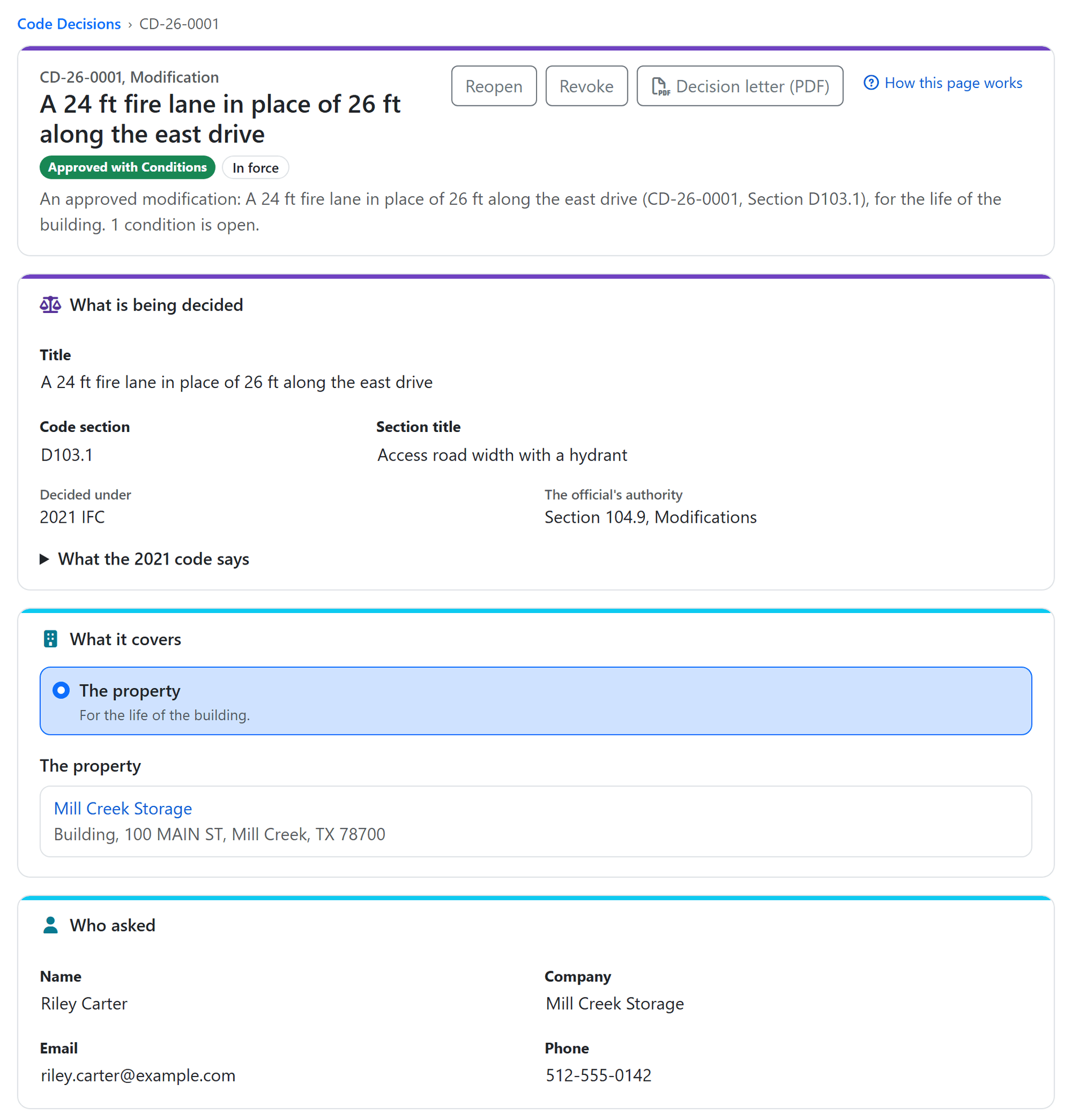
Shown with sample data. Click the image to see the whole page.
Every decision numbered and filed on its property.
A code decision is the record of what was asked, what the code asks the fire code official to find, the evidence, the conditions and the decision. Each is numbered CD-YY-NNNN and filed on the property it covers, so it is still there years after the people who made it have moved on.
- One page, in order: what is being decided, what it covers, who asked, the request, the findings, the evidence, the conditions and the decision, in the order a decision is made.
- The code's own words: the sections a decision is made under are printed on the record, so nobody has to look them up.
- Drafts first: a record starts as a draft and is saved as often as needed. An approval is refused while anything is missing, and the page lists each missing item and where it goes.
- The letter from the record: the decision letter is a PDF made from the record when it is needed, with the decision, the conditions and who decided.
- Every action in the history: sending, accepting, deciding, revoking and reopening each write a line with who did it and when.
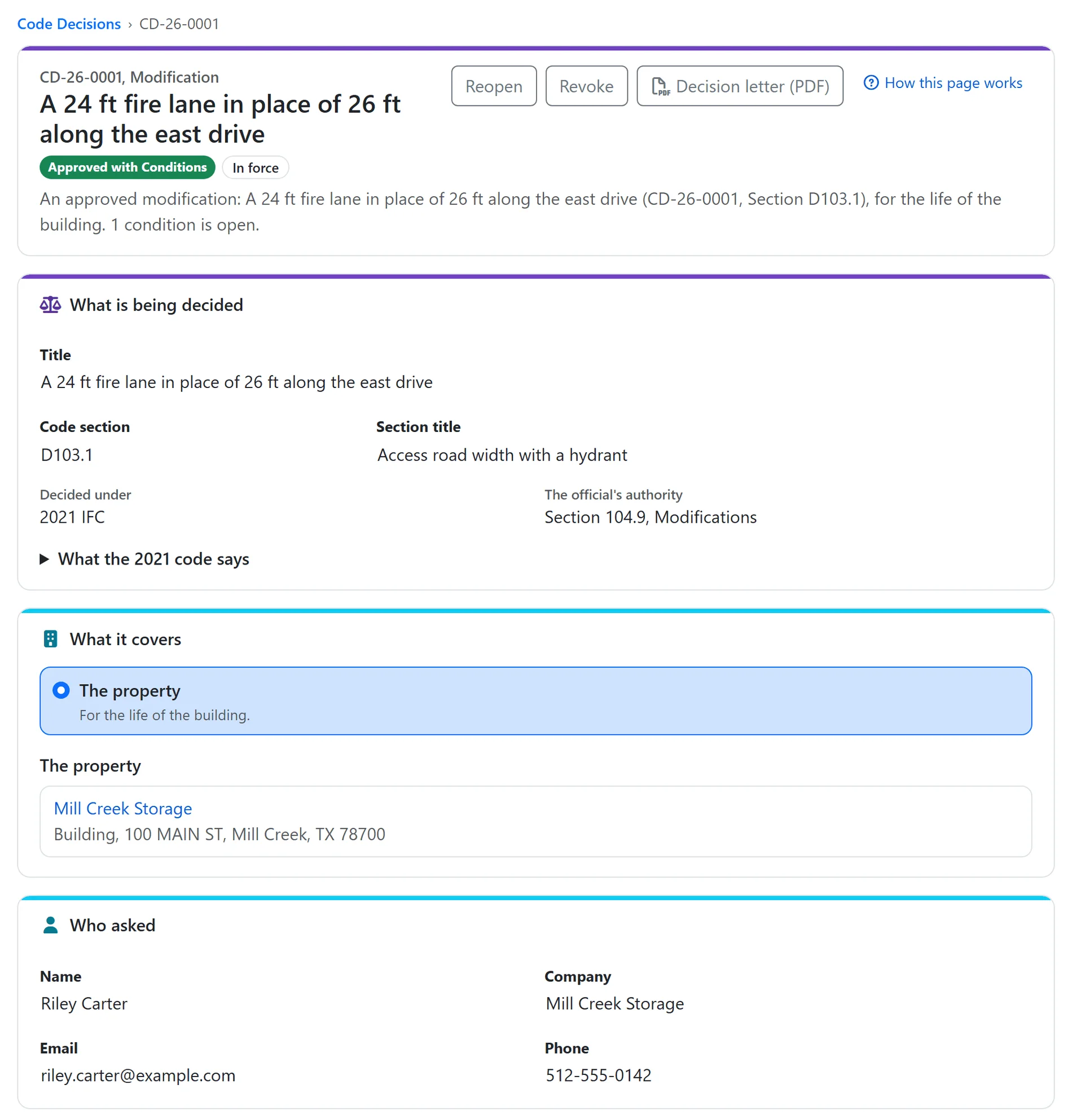
Shown with sample data.
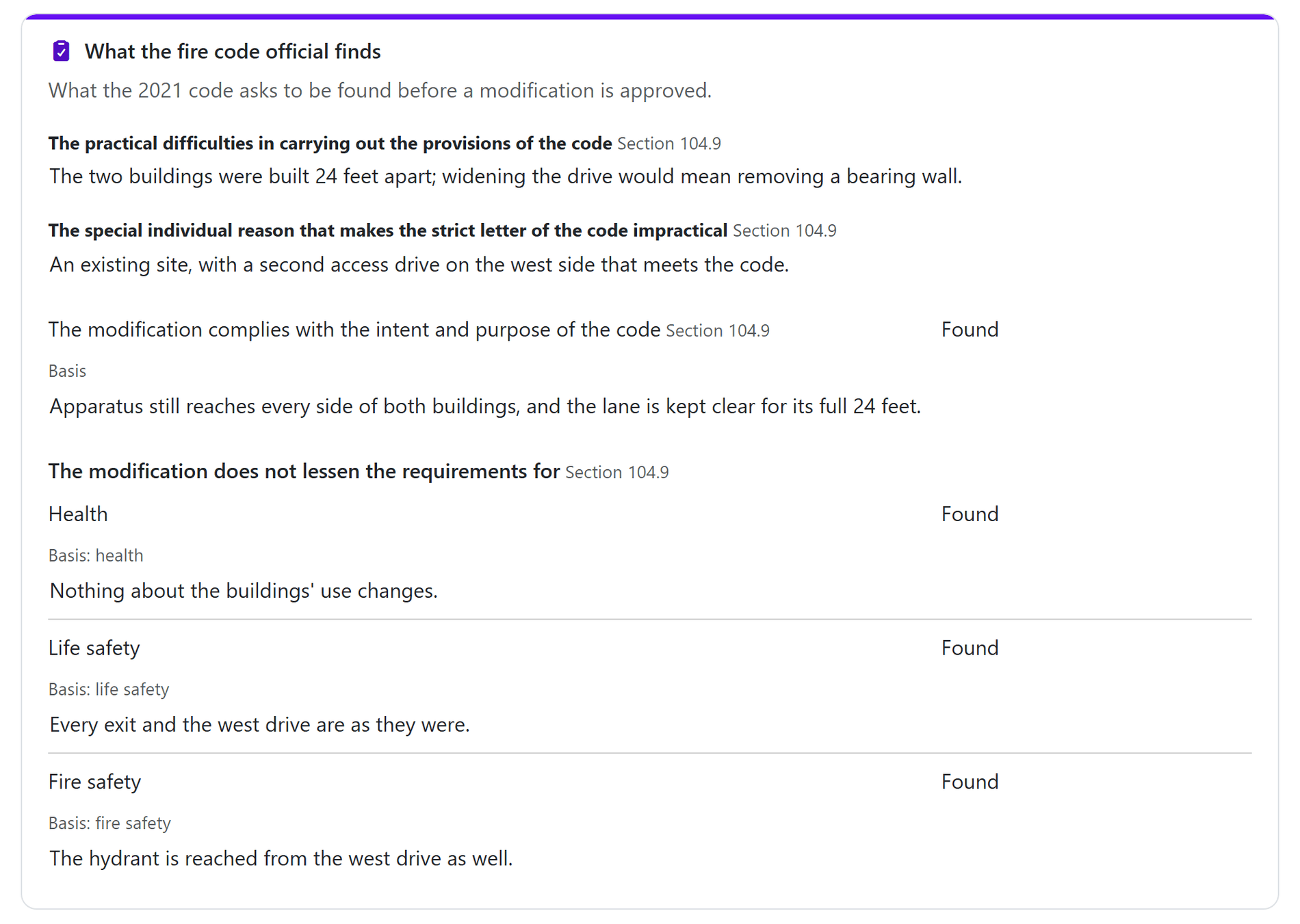
Shown with sample data. Click the image to see the whole page.
The findings your edition asks for, in its own words.
Each record follows the edition of the International Fire Code that applies at its property, from the 2015 IFC through the 2027 IFC. The form asks for what that edition asks the fire code official to find, under that edition's section numbers, and nothing else.
- Modifications: the practical difficulties, the reason particular to the property, and each finding the section names, every one with the basis for it.
- Alternative methods: the findings that the proposal is satisfactory and at least the equivalent of what the code prescribes, with the evidence behind them.
- The edition at the property: read from the property's own fire code, and another edition only with a reason recorded.
- The ICC Performance Code: under the 2024 and 2027 IFC, an alternative method may be decided under the Performance Code, with how it complies in place of the findings.
- Only what the edition names: disaster policies are offered under the 2024 and 2027 IFC, which provide for them, and under no earlier edition.
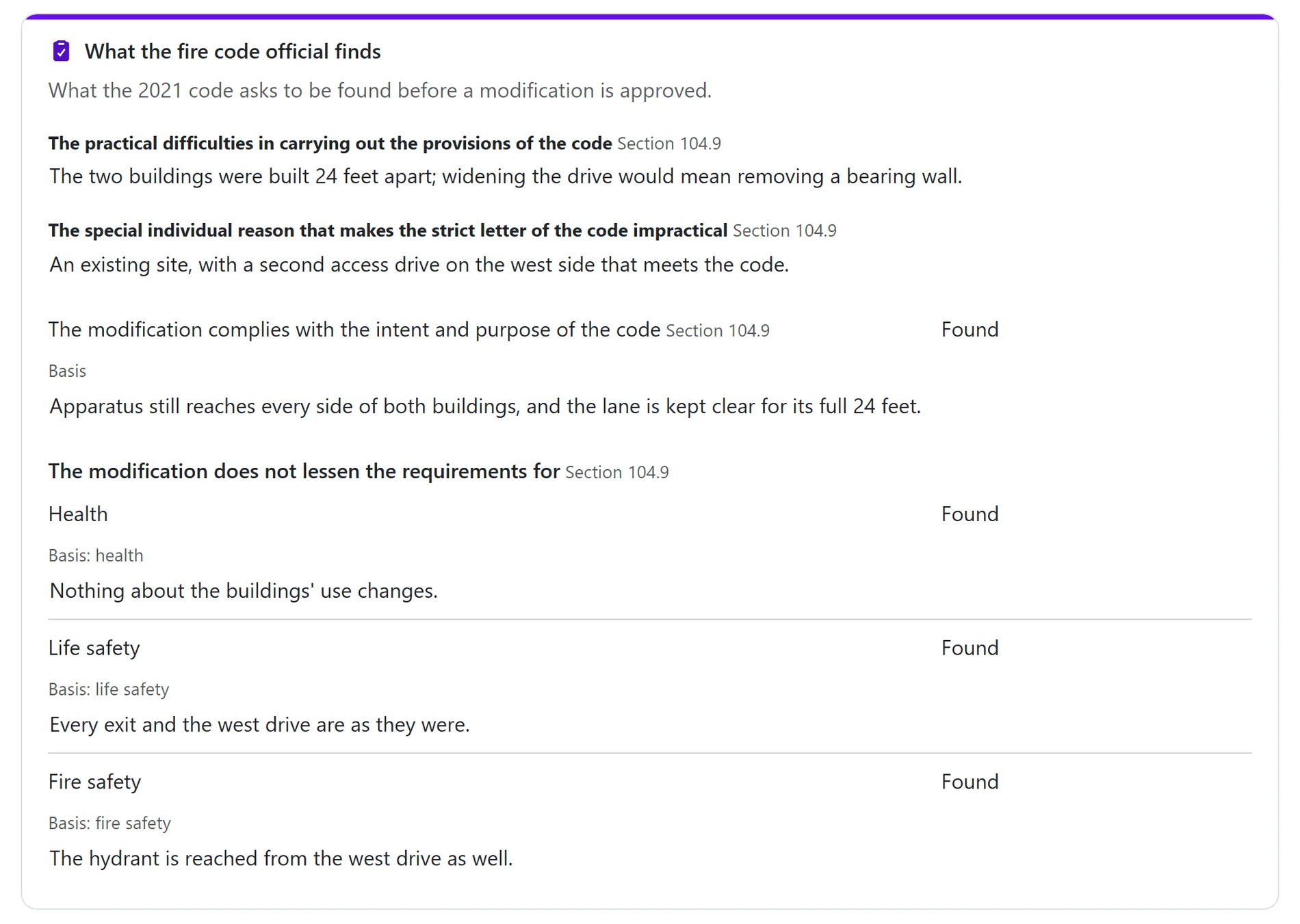
Shown with sample data.
Shown with sample data. Click the image to see the whole page.
Tests and reports from parties you approved.
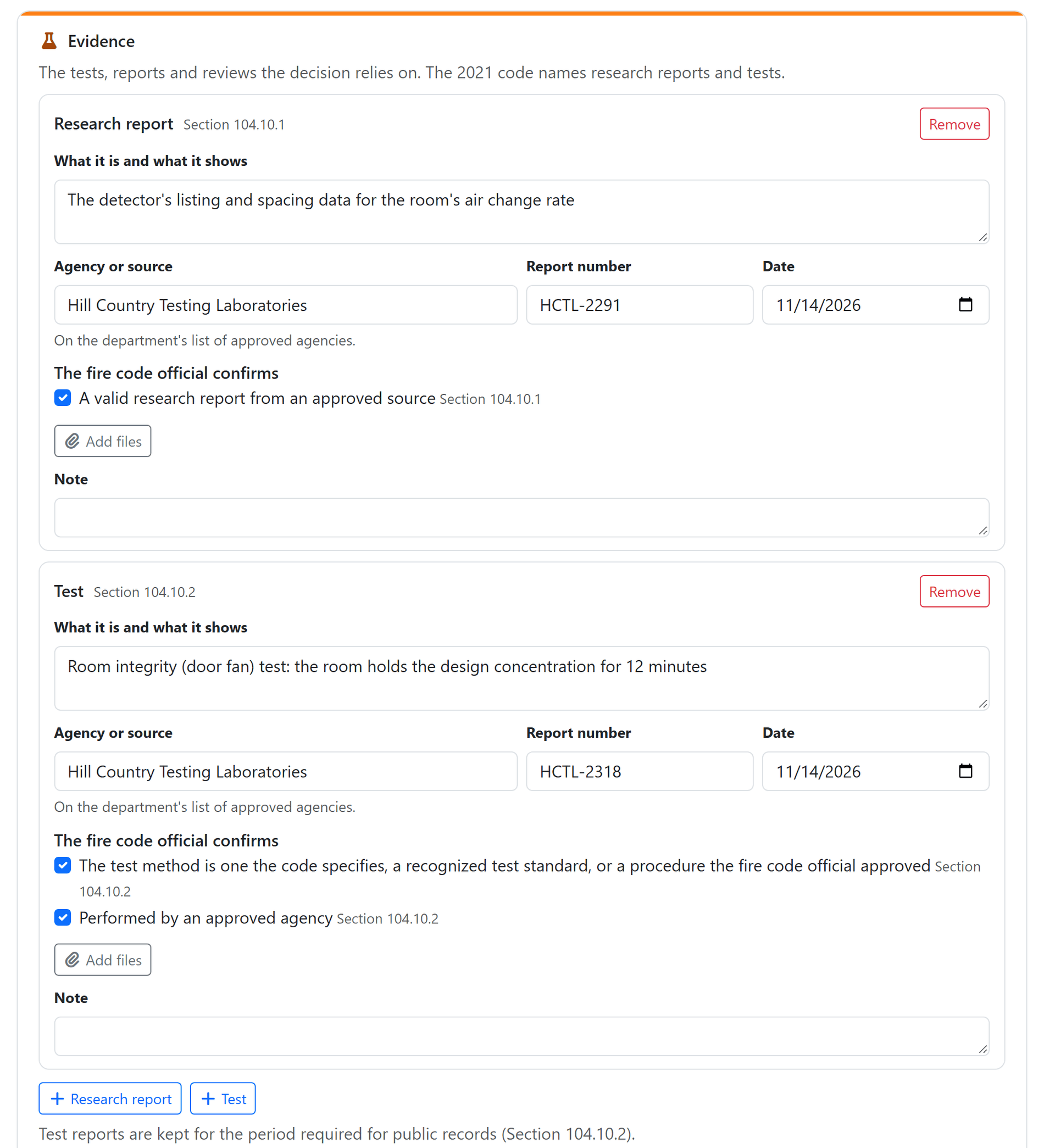
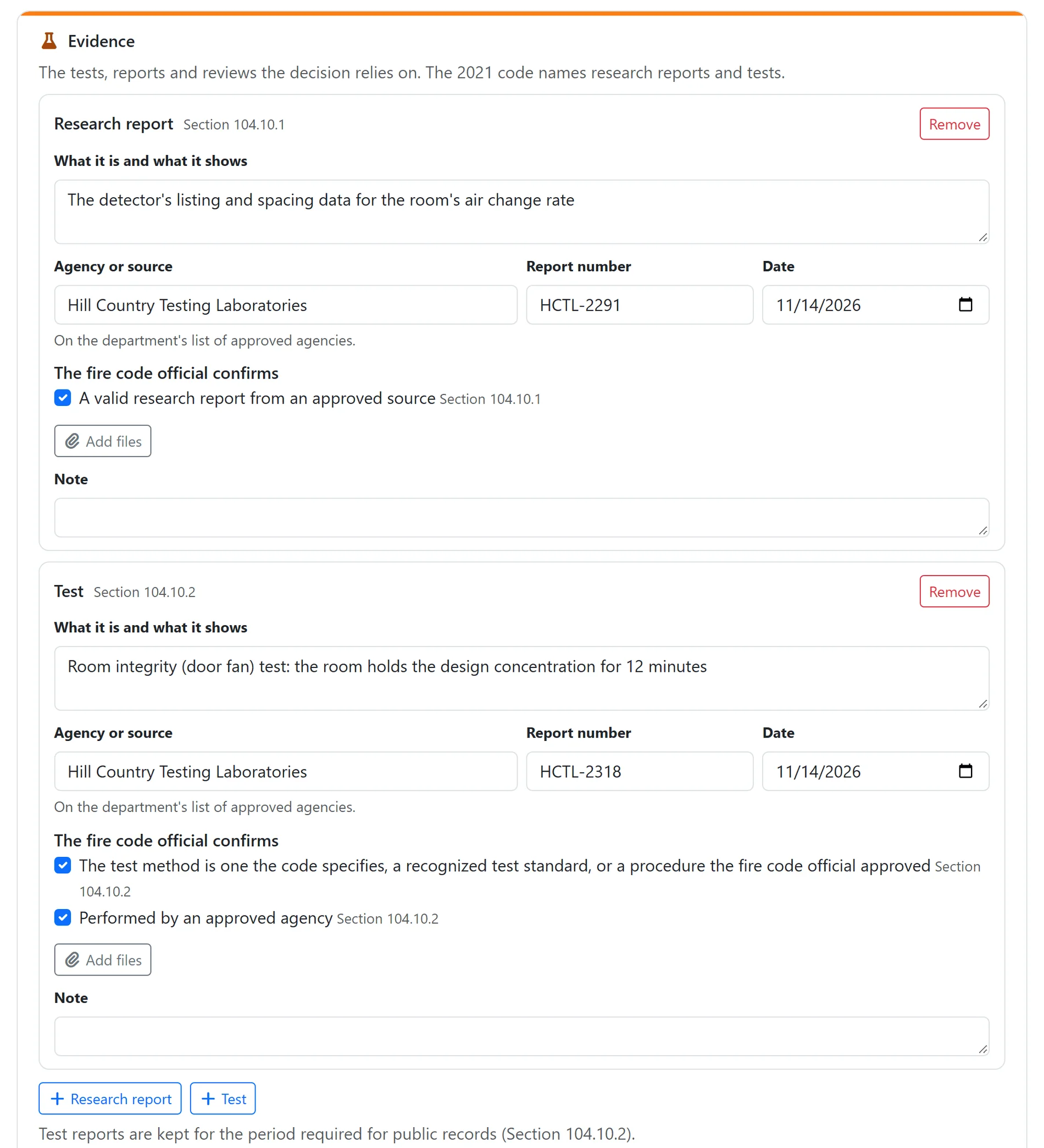
The newer editions ask that tests, research reports and peer reviews come from parties the fire code official has approved. Your department keeps those lists, and every piece of evidence says whether the name on it is one of them.
- Three lists: approved agencies, the engineers, specialists and laboratories acceptable to the fire code official, and approved peer reviewers.
- Offered as you type: names on the department's lists are offered on the Evidence card, and evidence from anyone else reads as not on the list.
- The official's checks: each kind of evidence carries the checks its edition names, such as a valid research report from an approved source.
- Approvals that end: a name no longer approved stays on the list as a record, and decisions that already name it keep it.
- A sealed letter, where you require one: a department may require a request to come as a letter signed and sealed by a licensed engineer or architect, and staff confirm the seal before it moves on.
Shown with sample data.
Shown with sample data. Click the image to see the whole page.
Conditions tracked until they are met.
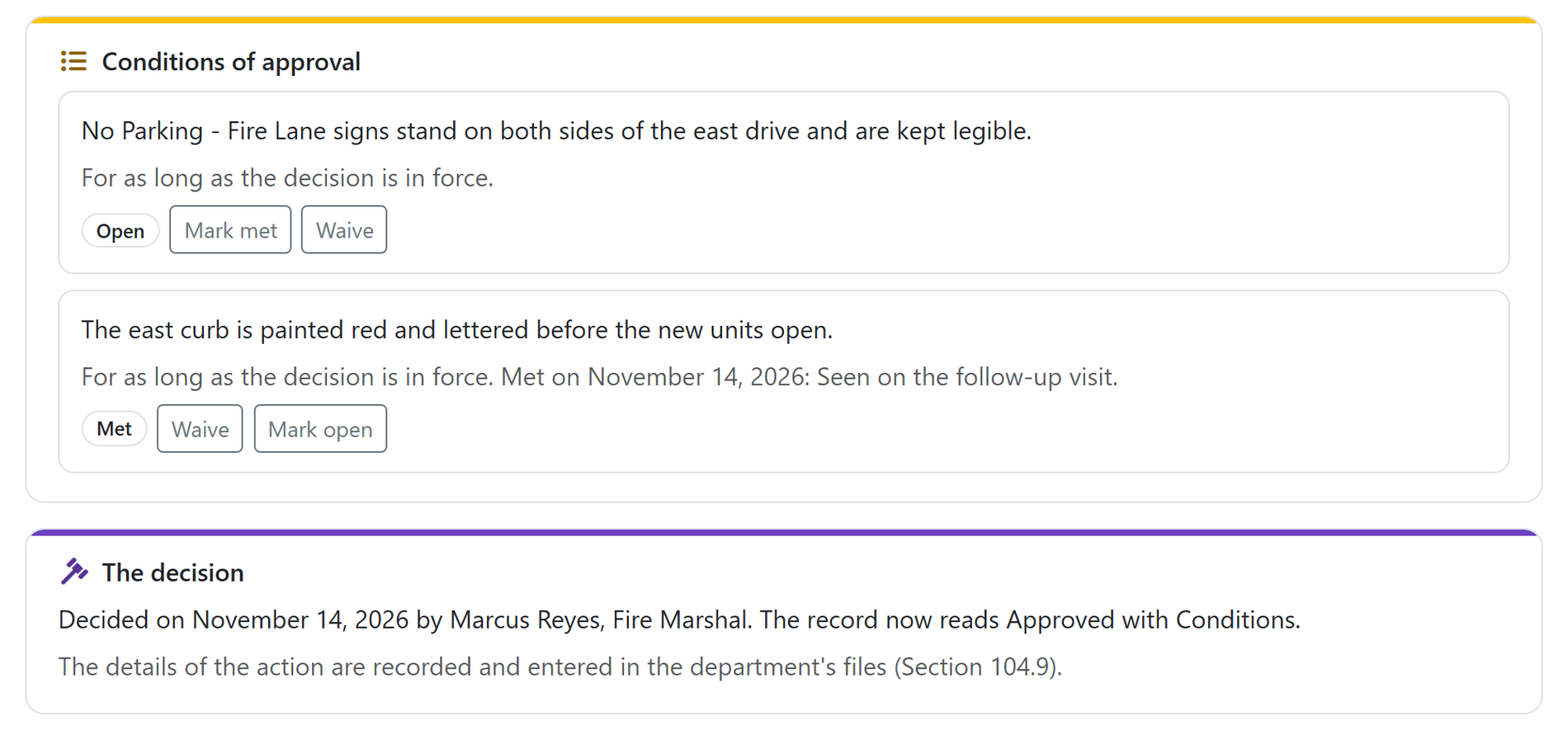
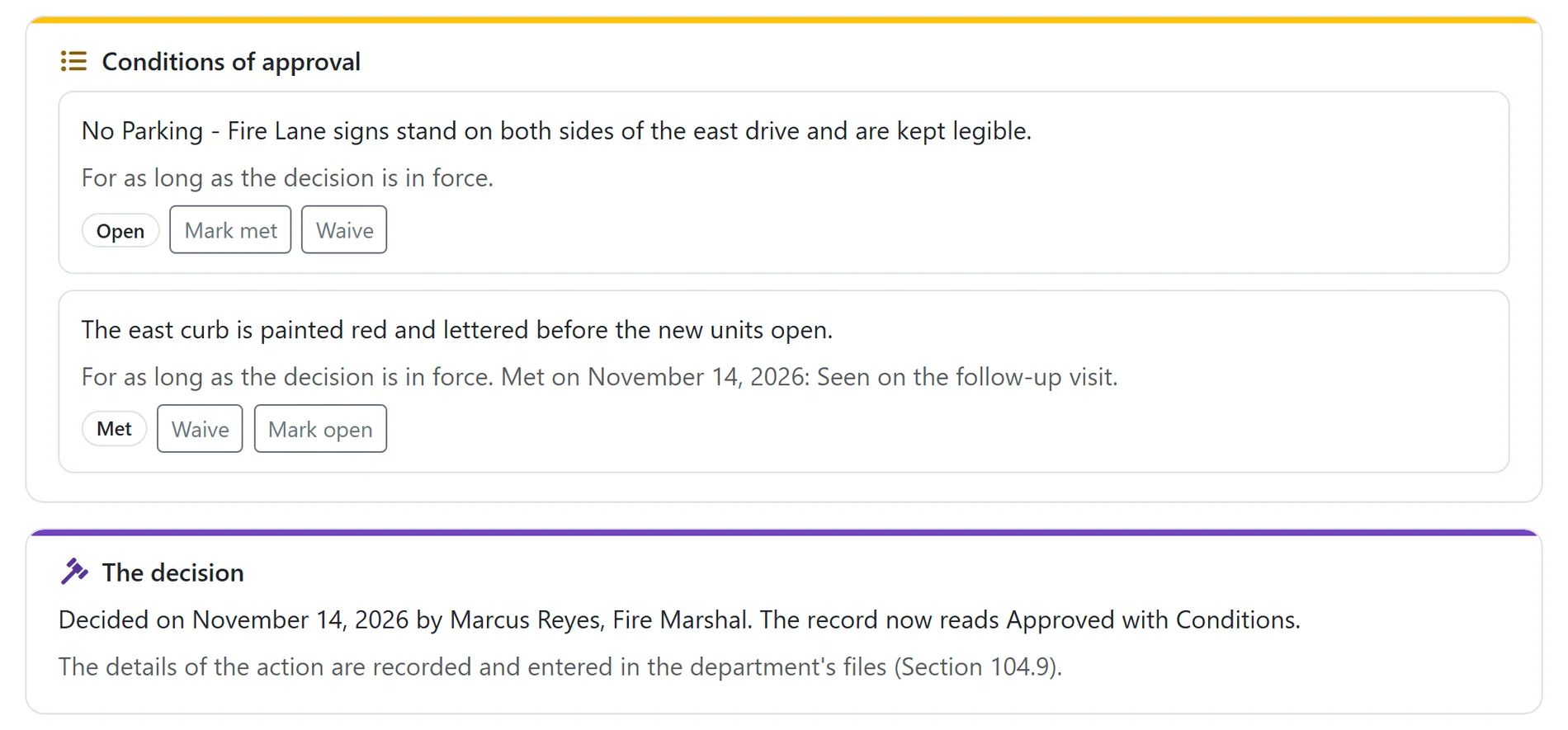
An approval with conditions keeps them on the record, each marked met, waived or open again with the day and a note. The record says how many conditions are still open, and the decision names who decided, under what title, and when.
- Three outcomes: Approved, Approved with Conditions, or Not Approved with the reasons written down.
- In force, or not: a decision in force can be revoked or reopened from the record, and the record says when it is no longer in force.
- Two permissions: Code Decision Edit for the staff who prepare requests, Code Decision Approve for the fire code official and anyone the official has delegated to.
Shown with sample data.
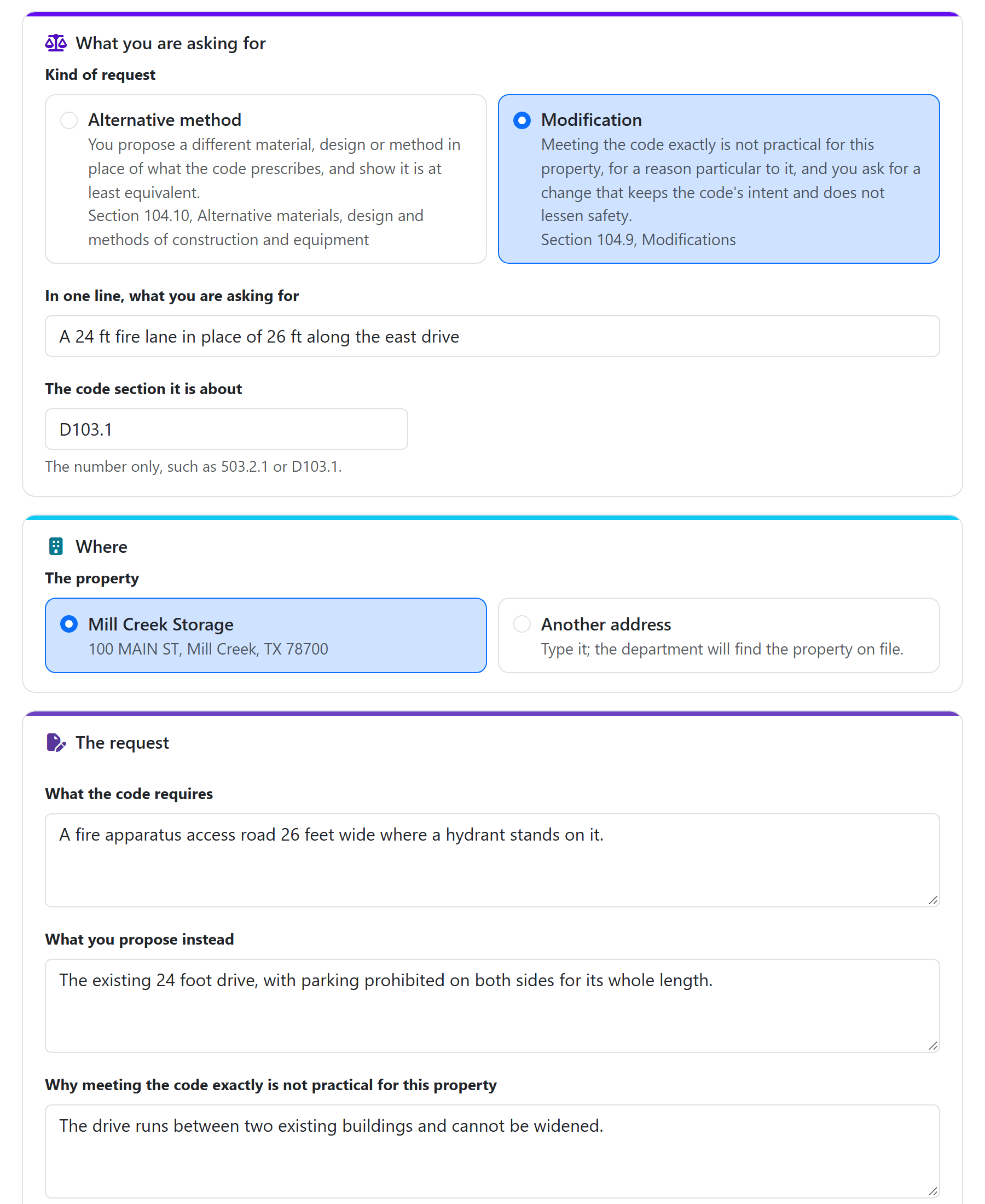
Shown with sample data. Click the image to see the whole page.
Requests arrive in writing, and complete.
Where your department takes requests online, a property owner or a design professional asks from your public site: what they ask for, the code section, what the code requires, what they propose instead and why, with their files. Staff check it before it is reviewed, and send it back with a note when it is incomplete.
- Their own properties: they choose a property they manage or one of their permits, or type the address and your staff find it on file.
- Returned with a note: the person who asked corrects the request on their own page and sends it again. It is the one way they add to a request, so nothing reaches the reviewer unasked.
- Emailed at every step: received with its number, accepted, returned with your note, and decided with its letter, each in your department's own wording.
- Your staff told: everyone who prepares or decides code decisions is emailed when a request arrives, or the addresses you choose instead.
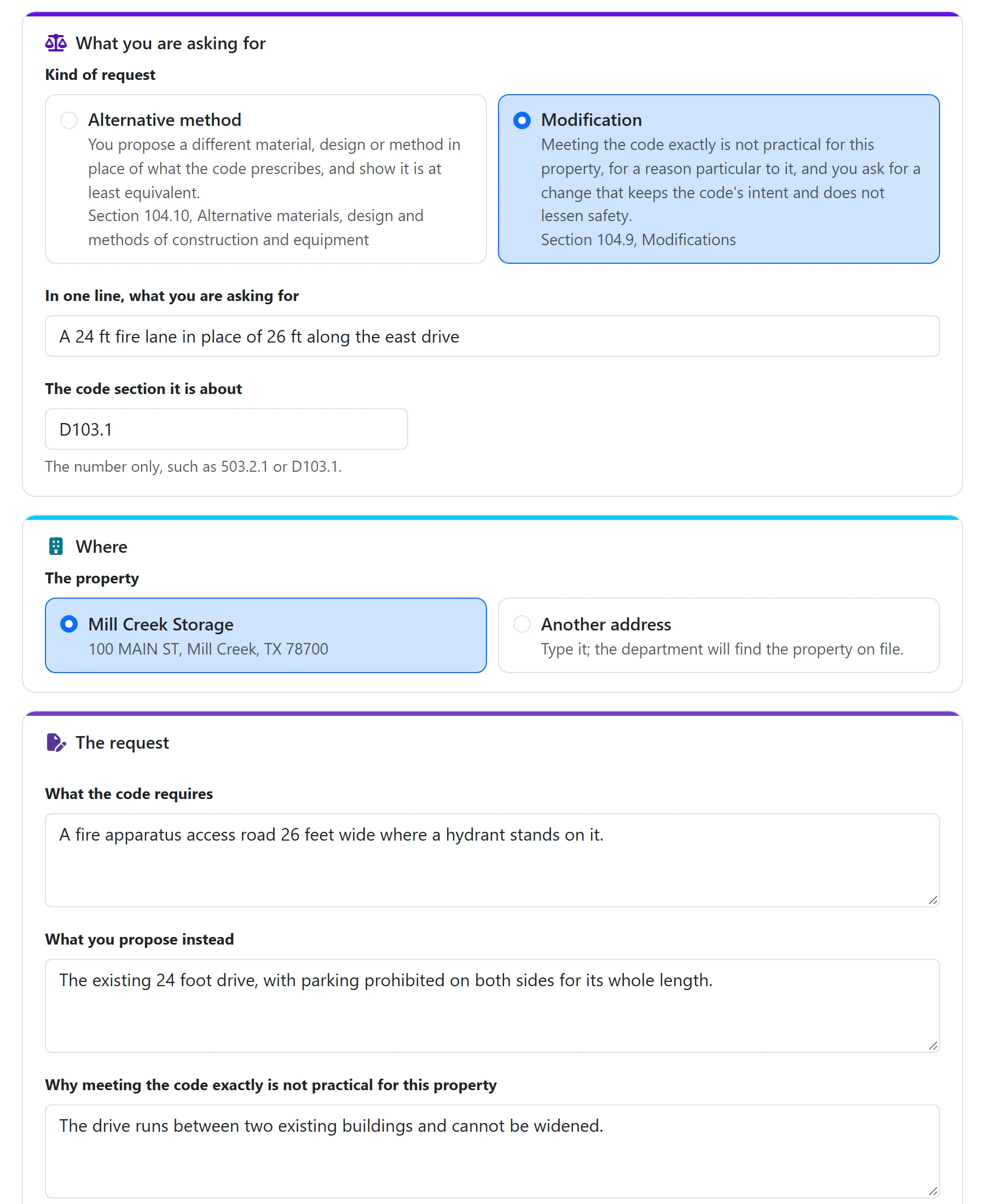
Shown with sample data.
And that is only the start
At the next inspection
A violation whose code section a decision covers carries a chip naming the decision, so the inspector sees it before writing the violation up.
At plan review
The permit's Before you review card lists the decisions in force at the property, those being decided, and those decided for the permit.
On the property
The property page and its briefing list what covers it. A decision filed on a Site covers its Buildings and their Tenants, and a decided one prints in the property records packet.
Disaster policies, published
Under the 2024 and 2027 IFC, a written policy during a disaster covers the whole department and is published on your public site, with no sign-in, while it is in effect.
Your variance permits come with you
FireInspection360 records the variance permits you already decided as code decisions on their properties, with the permit kept and marked.
Nothing changes behind you
A decision keeps every name as it was written, so changing the department's lists later never changes a decision already made.
See it with your own fire code edition.
A one-hour walkthrough with a fire prevention expert, or the demo site right now.