
Built for prevention, not bolted onto response.
Most fire department software is a records system for the engine crews with a prevention module added later. FireInspection360 is the opposite: a platform where the permit desk, the inspector and the investigator are the whole point.

Fire marshals and fire districts
Not generic city inspectors. Every module is built for the prevention side of the house.
Bootstrapped and founder-led
100% bootstrapped. No private equity, and no investors to satisfy at your renewal.
The people who built it
US-based support, extremely responsive. When you call, you talk to the developers.
Days, not months
Implementation measured in days, with the whole team trained by fire prevention experts.

A platform for the fire marshal's office, not a square peg in a round hole.
Most vendors build a records system for the engine crews and tack on generic inspection and investigation modules as an afterthought. We did the opposite. FireInspection360 is built exclusively for the complex business of the fire marshal's office: tools designed for the flow of plan reviews, permits and investigations, not a general-purpose form bent to fit them.
- Complex fee automation: stop using a calculator at your desk. The system calculates complex permit fees from square footage, occupancy type or sprinkler heads, so you collect every dollar your district is owed.
- True cradle-to-grave tracking: unlike siloed systems, we connect the entire history of a property. From the plan review redlines to the permit, the annual inspection and even an arson investigation, every data point is linked.
- NFPA-compliant workflows: our logic is built on the code. Whether it is an annual fire alarm test or a complex code enforcement case, the software guides you through a legally defensible workflow that stands up in court.

The public does the data entry. You keep control of the record.
Your inspectors should not spend hours on data entry or chasing down checks. We move the workload to the public: contractors apply, upload plans and pay fees online. But they do not dump data into your system. A safety-check validation layer means the public does the heavy lifting while your staff decides what enters your records.
- 24/7 self-service portal: contractors and business owners do the work for you. They create applications, upload documents and enter project details online, which cuts your administrative overhead and ends the "what is the status of my permit" phone calls.
- The safety check and enforced addresses: we stop bad data at the door. Every submission goes into a validation queue where your staff reviews it before acceptance, and validated street addresses are strictly enforced, so duplicate properties never get in and your data stays clean for the long haul.
- Pre-payment revenue capture: stop chasing bad debt. Payment is required before a permit is issued or an inspection is scheduled, so revenue never leaks and the money is in the bank before the truck leaves the station.

Not owned by private equity. Not run through a call center.
We are not owned by a private equity firm looking to squeeze profits, and we do not treat departments like numbers on a spreadsheet. We are a US-based team of developers and fire service veterans who believe in fair business. We care about fire safety, and it shows in how we treat the departments that use our tools.
- Flat, predictable pricing: a simple annual fee with no per-seat licenses. You get unlimited users, and your price will not suddenly double because we were acquired by an investment firm.
- US-based, direct support: when you call, you talk to the people who build the software. We resolve most issues within 24 hours and give clear, expert answers without a single overseas call center.
- We build what you ask for: the platform evolves from customer feedback. When you request a feature, we listen and we build it, often deploying it within weeks, not years.
A prevention module inside a monolithic RMS, side by side with a platform built for prevention.
A records system the whole department uses for everything is built for response. Dispatch, incidents and staffing get the attention; prevention gets a module, and the module gets whatever is left.
| A prevention module inside a monolithic RMS | FireInspection360 | |
|---|---|---|
| Built for | The engine crews and dispatch. Prevention gets what is left. | The fire marshal's office, every module. |
| Implementation | Months, often quarters, with prevention last in line. | Days, with expert-led training for the whole team. |
| Permit fees | A generic fee field and a calculator at the desk. | Calculated by your rules: square footage, occupancy type, sprinkler heads. |
| The property record | Permits, inspections and investigations in separate silos. | One record from plan review redlines to the arson investigation. |
| Data quality | Whatever the public types. | A validation queue and enforced street addresses. |
| Support | A ticket queue that serves the whole department. | US-based, from the people who built it. Most issues resolved within 24 hours. |
| Pricing | Per-seat licenses, modules priced one by one, increases at every renewal. | One flat annual fee, unlimited users. |
| Ownership | Often private equity, with the renewal price to match. | 100% bootstrapped and founder-led. |
| Feature requests | A multi-year roadmap. | Built from customer feedback, often within weeks. |
| Investigations, ITM reports, fire watches | Left to spreadsheets, inboxes and paper logs. | Modules of their own on the same property record. |
| Where to inspect next | A list someone builds by hand from whatever the module exports. | A priority queue scored from every module's records, with the reasons printed beside every score. |
Our growth is word of mouth from fire departments, and we have never lost a customer. Read what departments say after switching.
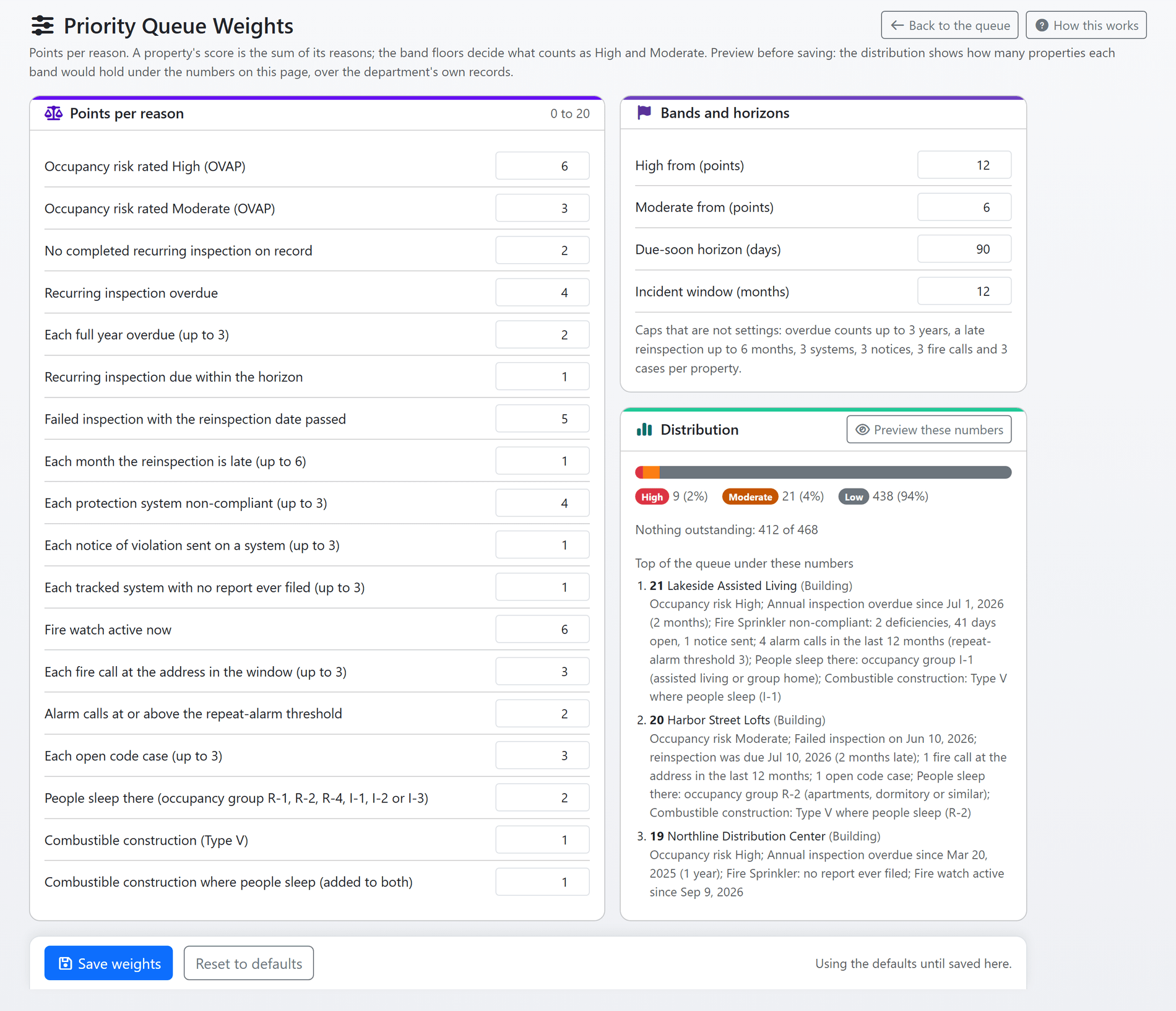
The Weights page, shown with sample data. Click the image to see the whole page.
Limited inspectors, pointed at the properties that need them most.
This is what one property record for every module is for. The priority inspection queue scores every building and tenant space from what the department already knows about it, the OVAP risk rating, an overdue recurring inspection, a failed inspection whose reinspection date has passed, a protection system tagged non-compliant, an active fire watch, fire calls at the address, an open code case, a sleeping occupancy, combustible construction, and ranks them. A prevention module inside a monolithic RMS cannot do this, because the facts it would need live in modules that never meet.
- Every point is a sentence: a row's score is the sum of printed reasons, dated where the record carries a date, so the order stands up to the chief, the owner and the council.
- Your weights, previewed first: the fire marshal sets the points, the band floors and the horizons, and sees how many properties each band would hold before saving.
- Nothing to maintain: the facts are read from the records at load time. Close the fire watch, file the ITM report or pass the reinspection and the property moves on its own.
- Straight into accreditation: the same numbers write the target hazard analysis and the community risk priorities of the Community Risk Assessment document.
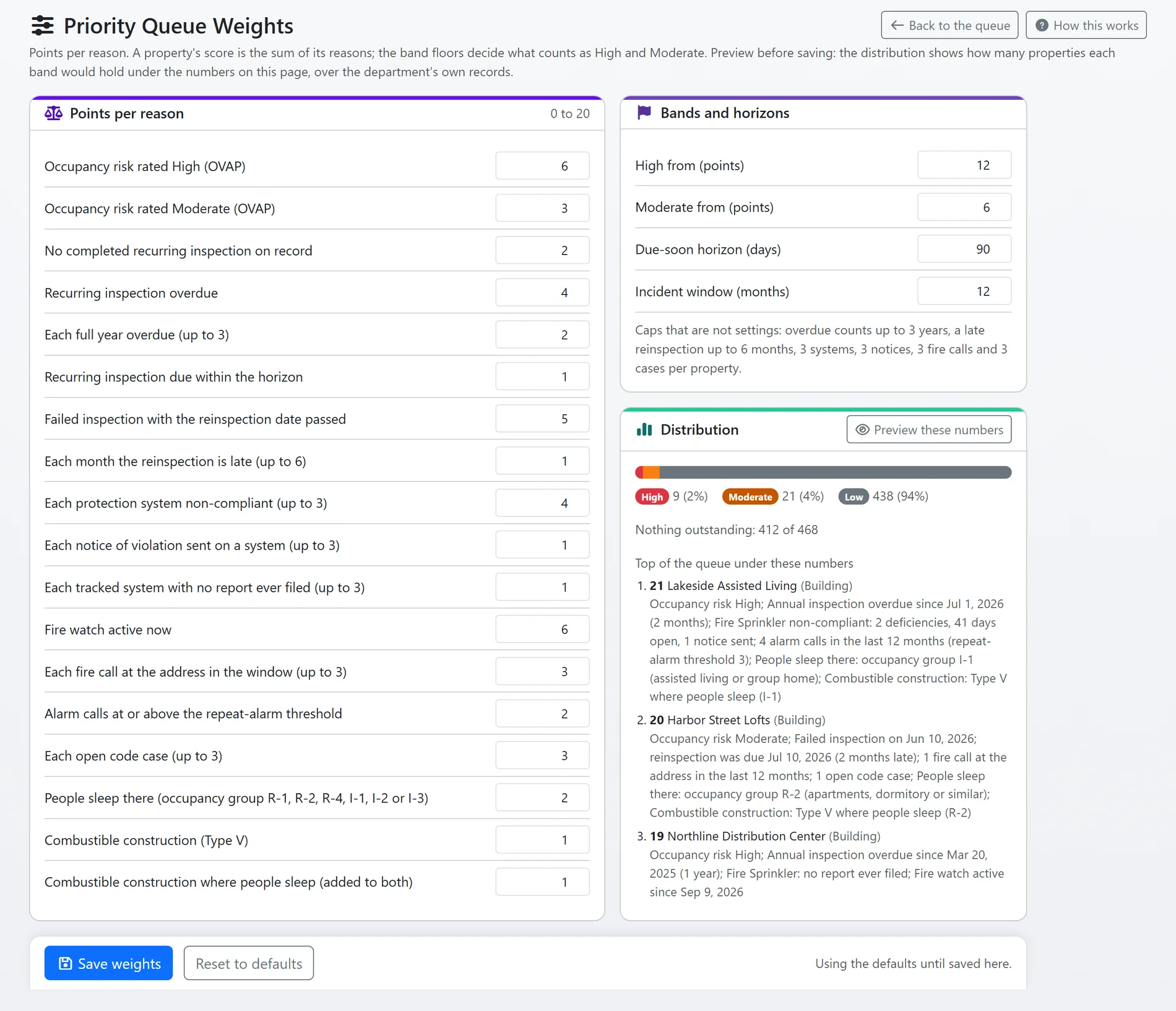
Shown with sample data.
Workflows you will not find in a generic prevention module.
FireInspection360 is dedicated exclusively to the prevention and code enforcement side of the house. These are not afterthoughts bolted onto a dispatch system. They are purpose-built workflows for fire marshals who need precision, not bloat.
Stop discovering NFPA 400 violations at the worst possible moment
The chemical inventory and hazardous materials tracking module changes how a prevention bureau manages one of the most legally complex parts of code enforcement. When a business owner submits a permit application through the public portal, the system prompts for the hazardous materials stored, classifying each chemical by its NFPA 400 and IFC Chapter 50 hazard category before the permit is approved. Inspectors arrive with a chemical inventory already tied to the property record and check it against the maximum allowable quantity (MAQ) thresholds on site. When a violation is found, the violation notice is generated and the compliance re-inspection follows, so nothing falls through the cracks.
Scale your CRR program without scaling your headcount
For prevention bureaus with growing occupancy inventories and flat inspection staffing, the self-inspection portal is a force multiplier for a Community Risk Reduction program. Designated low-risk occupancy types (multi-family residential units, small retail tenants, office occupancies) can be enrolled in a self-inspection program where the responsible party receives a secure, mobile-friendly checklist from the bureau. Property managers complete the inspection, submit photos for the key life safety items and certify the result electronically, inside a workflow the fire marshal controls. Every submission is logged to the property's compliance record, flagged for AHJ review when a deficiency is reported, and counted in the annual CRR metrics.
Replace the paper log. Close the accountability gap.
Manual fire watch logs and paper special-event permit approvals are operationally risky and hard to defend in a post-incident review. The fire watch and open burning permit modules replace paper logs and spreadsheet trackers with one cloud-based record that gives the bureau complete visibility into every active fire watch and open burn authorization in its jurisdiction, at any moment, from any device. When a property is placed under a temporary fire watch, the responsible party logs each round into a timestamped fire watch log. Special event permits flow through a configurable approval workflow that notifies the AHJ, routes the application for code review and generates the official permit document on approval.
Book a walkthrough built around your department.
A one-hour session with a fire prevention expert, set up with your own permit types, fee schedule and inspection forms so you see how your work would run. Or open the demo site right now, no registration.